What Was God's First Temple? The Story of the Kashi Vishwanath in Varanasi
Kashi Vishwanath: Myth vs. History Explorer
Click on a timeline event to see detailed facts.
Select a Period
Choose a date from the timeline on the left (or top on mobile) to reveal specific details about that era in the temple's history.
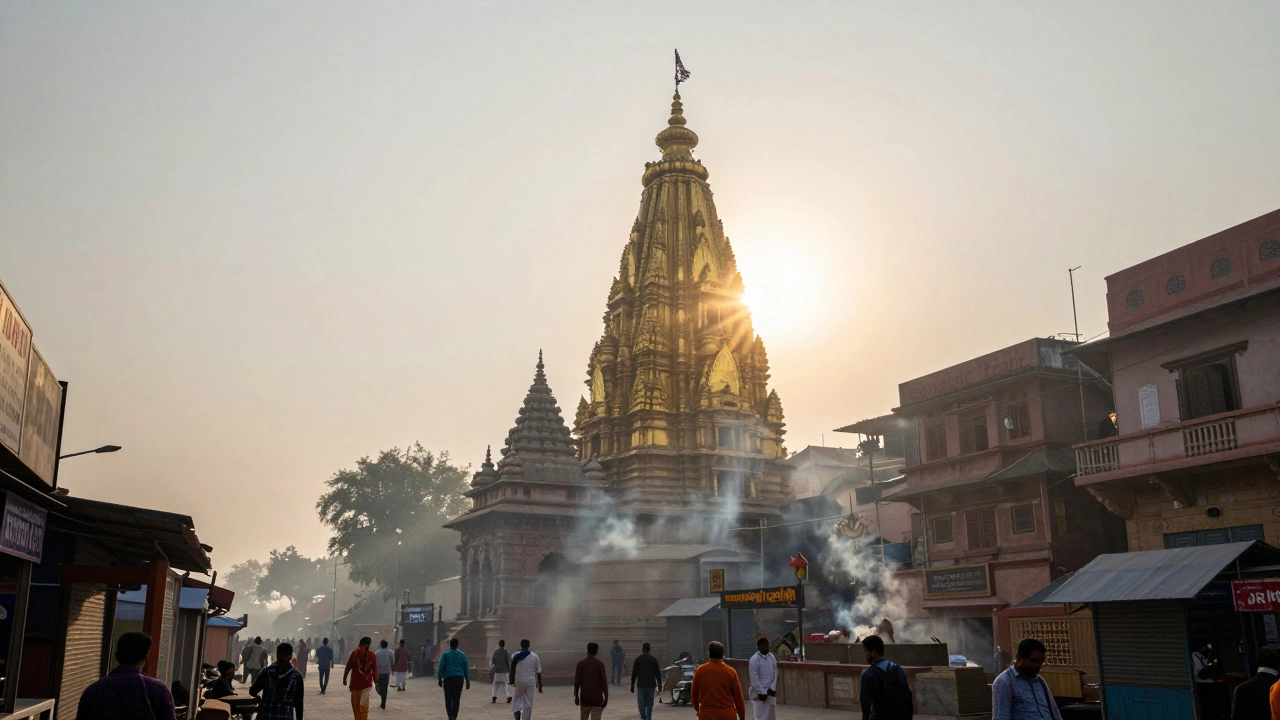
You stand on the narrow, bustling streets of Varanasi. The air is thick with incense and the sound of bells. You look up at a golden spire piercing the morning sky. This isn't just any temple. For millions of devotees, this is Kashi Vishwanath, widely revered as the first temple built by human hands dedicated to Lord Shiva. But wait-was it really the *first*? And what about that story where Shiva himself appeared here before anyone laid a brick?
The question "What was God's first temple?" usually leads to one answer: the Kashi Vishwanath Temple in Varanasi (also known as Benares). However, the reality is a mix of theology, archaeology, and centuries of political struggle. It’s not just a building; it’s a cosmic pivot point in Hindu belief.
The Mythological Origin: Before Humans Existed
To understand why this temple holds such weight, you have to look past the stone and mortar. In Hindu mythology, time isn't linear like we think of it. It cycles. According to the Shiva Purana, a sacred text detailing the glory of Lord Shiva, the Jyotirlinga (pillar of light) at Kashi appeared spontaneously.
Legend says that Brahma and Vishva were arguing over who was superior. To settle the dispute, Shiva manifested as an infinite pillar of fire. Neither god could find its beginning or end. That pillar became the Jyotirlinga, one of twelve sacred representations of Shiva, and the spot where it stood became Kashi.
So, technically, if we follow the myth, there was no "construction." The deity was already there. The temple was merely a structure built around a pre-existing divine presence. This concept is crucial for pilgrims. They don't visit Kashi to worship a statue; they visit to witness the eternal flame that has burned since the dawn of creation.
The Historical Reality: Who Actually Built It?
Mythology gives us the spiritual timeline. History gives us the bricks. If you ask historians, "Who built the first physical temple at this site?", the answer gets complicated because the original structures are lost to time and destruction.
We know from inscriptions that a temple existed here during the reign of the Gupta Empire, a classical golden age of Indian history spanning roughly 320-550 CE,. But the specific claim that it was the "first" often points to two different narratives depending on who you talk to.
The Raghunath Singh Claim: Many modern accounts credit Maharaja Raghunath Singh of Benares with building the current structure in 1780. He raised funds across India to reconstruct the temple after it had been destroyed multiple times. While he built the *current* iconic version, he wasn't the first to build *any* temple here.
The Ancient Origins: Archaeological evidence suggests continuous worship at this site for over 3,000 years. Some scholars argue that the earliest substantial stone temple might have been commissioned by King Harshavardhana in the 7th century, or even earlier by local rulers during the Mauryan period. The key takeaway? The site has never been empty. Even when the main temple was demolished, smaller shrines or underground chambers allowed worship to continue.
Why Is It Called the "First" Temple?
If other temples like the Somnath Temple, located in Gujarat, also claims ancient origins, exist, why does Kashi get the title? It comes down to three factors:
- Geographical Centrality: In Vedic geography, Kashi is considered the center of the universe. It is believed that whoever dies in Kashi is liberated from the cycle of rebirth (Moksha).
- The Jyotirlinga Status: Among the 12 Jyotirlingas, Kashi is often listed first in many texts, giving it primacy.
- Unbroken Worship: Unlike many other sites that fell into ruin for centuries, Kashi maintained a near-continuous thread of devotion, even if the architecture changed.
It’s less about being the chronologically first brick laid in India, and more about being the most spiritually significant anchor point for Shaivism (worship of Shiva).
The Dark Chapter: Destruction and Rebuilding
You can’t talk about this temple without addressing the pain of its history. The temple didn’t stay standing forever. Between the 12th and 18th centuries, it faced repeated destruction during invasions.
The most famous incident occurred in 1669 under the Mughal Emperor Aurangzeb. The temple was demolished, and a mosque (the Gyanvapi Mosque) was built on part of the complex. However, the sanctum sanctorum (the inner chamber housing the Shiva Linga) is said to have survived, either hidden underground or protected by local devotees.
This period highlights the resilience of the site. Every time the structure was torn down, it was rebuilt. Sometimes within months. Sometimes decades later. Each reconstruction added new layers of architectural style-from Nagara (North Indian) spires to intricate carvings reflecting the patronage of various Rajput and Maratha kings.
Visiting Today: What You Need to Know
In 2024, the temple underwent a massive renovation and re-consecration, making it more accessible than ever. If you are planning a trip to see this "first temple," here is what your experience will look like.
The Darshan Process: The temple now uses a ticketed entry system to manage crowds. You can book tickets online via the official website. There are different tiers of darshan (viewing):
- General Entry: Free but involves long queues. Not recommended for first-time visitors due to crowd density.
- Premium Darshan: Paid entry that allows faster access. This is the sweet spot for most tourists.
- VIP/Special Pooja: Includes private rituals performed by priests. Expensive but offers a deeply personal spiritual connection.
Dress Code and Etiquette: You must dress modestly. Shoulders and knees should be covered. Leather items (wallets, belts, bags) are strictly prohibited inside the temple premises. Leave them in the lockers provided outside. Also, note that photography is generally not allowed inside the main sanctum.
Best Time to Visit: Early morning (between 6 AM and 8 AM) or late evening (after 7 PM) offers the most serene atmosphere. Avoid major festivals like Maha Shivaratri unless you want to be part of a massive, chaotic, yet beautiful sea of people.
| Aspect | Kashi Vishwanath (Varanasi) | Somnath (Gujarat) | Badrinath (Uttarakhand) |
|---|---|---|---|
| Deity | Lord Shiva (Jyotirlinga) | Lord Shiva (Jyotirlinga) | Lord Vishnu |
| Mythological Origin | Spontaneous Jyotirlinga appearance | Built by Moon God Soma | Installed by Adi Shankaracharya |
| Historical Age | Over 3,000 years of continuous worship | Ancient, but current structure is 1951 | Temple rebuilt in 8th Century CE |
| Claim to "First" | Most cited as the first human-built temple | Often called the first of the 12 Jyotirlingas | One of the four Char Dham pilgrimage sites |
Is It Really the Oldest Structure in India?
Here is where we need to be precise. If you are looking for the oldest *standing* stone temple structure in India, Kashi Vishwanath is not it. The current building is largely 18th-century work. Older surviving structures include:
- Brihadeeswarar Temple (Thanjavur): Built in 1010 CE by Rajaraja Chola I. It is a UNESCO World Heritage site and stands almost exactly as built.
- Sundarnereswarar Temple (Kanchipuram): Dates back to the Pallava dynasty (7th-8th century).
- Rudreshwara Temple (Jambhali): A cave temple dating back to the Gupta period (5th century).
So, why does Kashi get the spotlight? Because in Hindu tradition, the *spiritual* age matters more than the *architectural* age. The belief is that the energy at Kashi is primordial. The building is just a container for something much older. When people ask "What was God's first temple?", they are usually asking about spiritual precedence, not archaeological records.
Practical Tips for Your Visit
Varanasi is intense. It is loud, crowded, and emotionally charged. Here is how to navigate it like a pro.
Getting There: Varanasi has an airport (Lal Bahadur Shastri International Airport) and a major railway station (Varanasi Junction). From the station, auto-rickshaws will take you to the temple area (Dashashwamedh Ghat area) in about 15-20 minutes, depending on traffic.
Where to Stay: Stay near the ghats if you want the full sensory experience. Hotels like the Taj Ganges offer luxury with river views. For budget travelers, guesthouses in Assi Ghat or Ramnagar provide easier access and lower prices.
Scams to Avoid: Be wary of "guides" who approach you aggressively near the temple entrance. Official guides are available through the temple trust. Also, do not buy antiques or religious items from street vendors claiming they are "blessed" or "ancient" without verification.
The Spiritual Significance Beyond Architecture
Ultimately, visiting Kashi Vishwanath is less about seeing a building and more about participating in a living tradition. The temple is open 24 hours a day. At any hour, you will find priests chanting, devotees offering milk and bilva leaves, and musicians playing devotional songs.
The concept of Kashi as the "City of Light" ties directly to the temple. It is believed that Shiva resides here to liberate souls. Whether you are a devout Hindu, a curious traveler, or a history buff, the sheer weight of centuries of faith concentrated in one small space is palpable. You can feel it in the vibrations of the bells and the silence of the worshippers.
So, was it the first temple? Historically, maybe not the very first brick. Spiritually, absolutely. It represents the starting point of conscious worship for millions. And that makes it the first temple that truly matters.
Is Kashi Vishwanath the oldest temple in India?
While Kashi Vishwanath is revered as the first temple built by humans for Shiva, it is not the oldest *standing* structure. Temples like Brihadeeswarar in Thanjavur (1010 CE) are older in terms of current architecture. However, Kashi has a continuous history of worship dating back over 3,000 years.
Who built the original Kashi Vishwanath Temple?
The original structure is lost to history, but inscriptions suggest temples existed during the Gupta era (4th-6th century CE). The current prominent structure was largely rebuilt by Maharaja Raghunath Singh in 1780, following several previous reconstructions after destruction.
Can non-Hindus enter Kashi Vishwanath Temple?
Yes. Non-Hindus are allowed to enter the temple premises and view the exterior, but they are generally not permitted to enter the inner sanctum (garbhagriha) where the Shiva Linga resides. This rule applies to most major Hindu temples in India.
What is the difference between Kashi Vishwanath and Somnath?
Both are Jyotirlinga temples dedicated to Shiva. Somnath is located in Gujarat and is often cited as the first of the 12 Jyotirlingas in some lists. Kashi Vishwanath is in Varanasi and is considered the most important for liberation (Moksha). Both have ancient roots but different mythological origins.
How much does it cost to visit Kashi Vishwanath?
General entry is free but involves long waits. Premium darshan tickets range from approximately INR 500 to INR 2,000 depending on the speed of access and additional services. VIP poojas can cost significantly more, ranging from INR 5,000 to over INR 50,000.
Is it safe to visit Varanasi at night?
Varanasi is generally safe for tourists, especially in well-lit areas near the ghats and the temple. However, like any crowded city, you should remain aware of your surroundings, avoid isolated alleys, and use registered taxis or app-based cabs for transport at night.
What is the significance of the Golden Spire?
The golden spire (gopuram) was added in recent renovations to enhance the temple's visibility and grandeur. Symbolically, gold represents purity and divinity, signifying the temple's status as a radiant beacon of faith in the City of Light.

About Author