Which Temple Is Richest in India? The Truth Behind the Wealth of India's Most Powerful Shrines
Temple Wealth Comparison Tool
Padmanabhaswamy Temple
Thiruvananthapuram, Kerala
Key Fact: Wealth stored in vaults sealed for centuries with religious significance.
Tirupati Balaji Temple
Tirupati, Andhra Pradesh
Key Fact: Wealth used for hospitals, schools, and free food programs serving over 100,000 daily.
How They Compare
Wealth Type
Padmanabhaswamy: Accumulated Treasure
Tirupati: Annual Income
Purpose of Funds
Padmanabhaswamy: Sacred Preservation
Tirupati: Public Service
Religious Significance
Padmanabhaswamy: Vaults are sacred
Tirupati: Donations are devotion
The question which temple is richest in India isn’t just about religion-it’s about history, power, and money on a scale most people never imagine. When you hear "richest temple," you might picture gold idols and marble floors. But the real story is deeper. Some of these temples hold fortunes that rival small nations. And no, it’s not just about donations. It’s about centuries of accumulated wealth, hidden vaults, and legal battles that still echo today.
Padmanabhaswamy Temple: The Hidden Billions
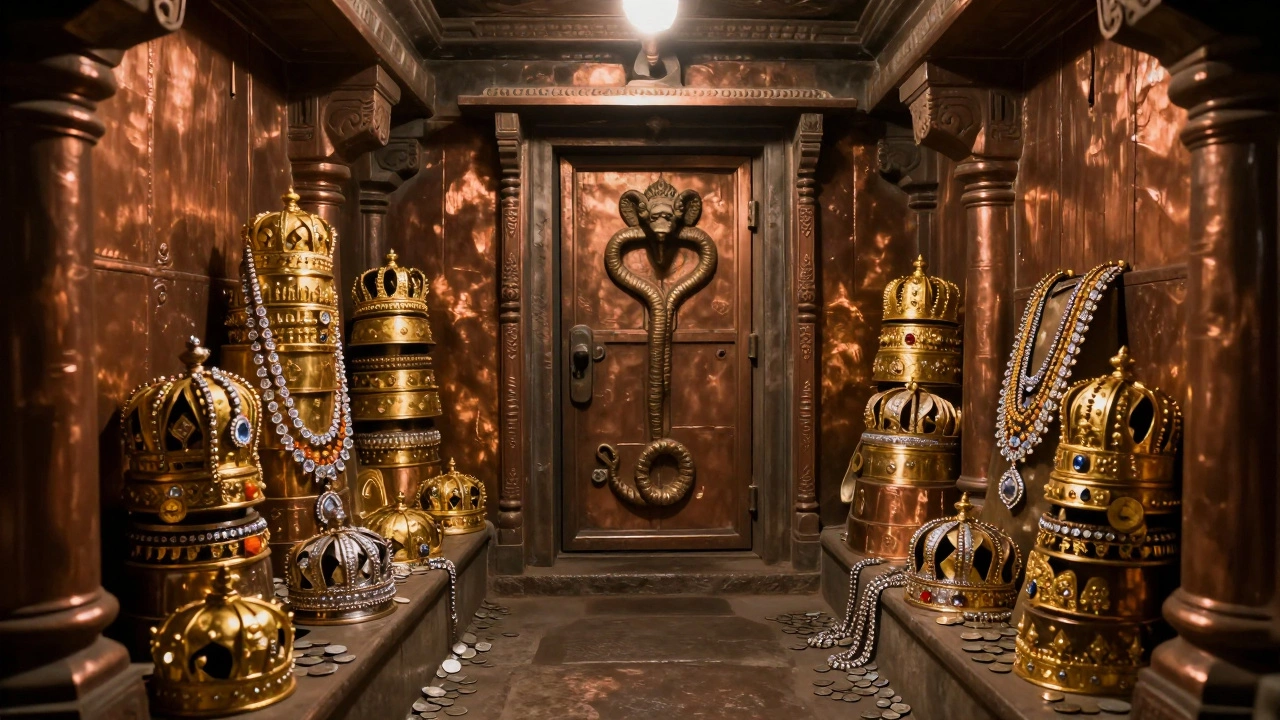
If you ask anyone in India which temple holds the most wealth, the answer will almost always be the Padmanabhaswamy Temple in Thiruvananthapuram, Kerala. Its vaults, labeled A through F, were opened in 2011 after a Supreme Court order. What they found stunned the world: gold crowns weighing over 50 kilograms, diamond-studded necklaces, silver coins from the 18th century, and chests filled with ancient jewelry. One vault alone contained an estimated $22 billion worth of treasure. That’s more than the GDP of 100 countries.
But here’s the catch: this isn’t cash in a bank. It’s sacred property. The temple trustees say the wealth belongs to the deity, Lord Padmanabha, and must never be touched. The Indian government can’t touch it. Even the state of Kerala doesn’t control it. The wealth is maintained, not spent. It’s stored in vaults lined with copper and sealed with ancient rituals. No one knows if Vault B even exists-its entrance is sealed with a mysterious serpent carving, and no one dares open it.
Tirupati Balaji: The People’s Temple
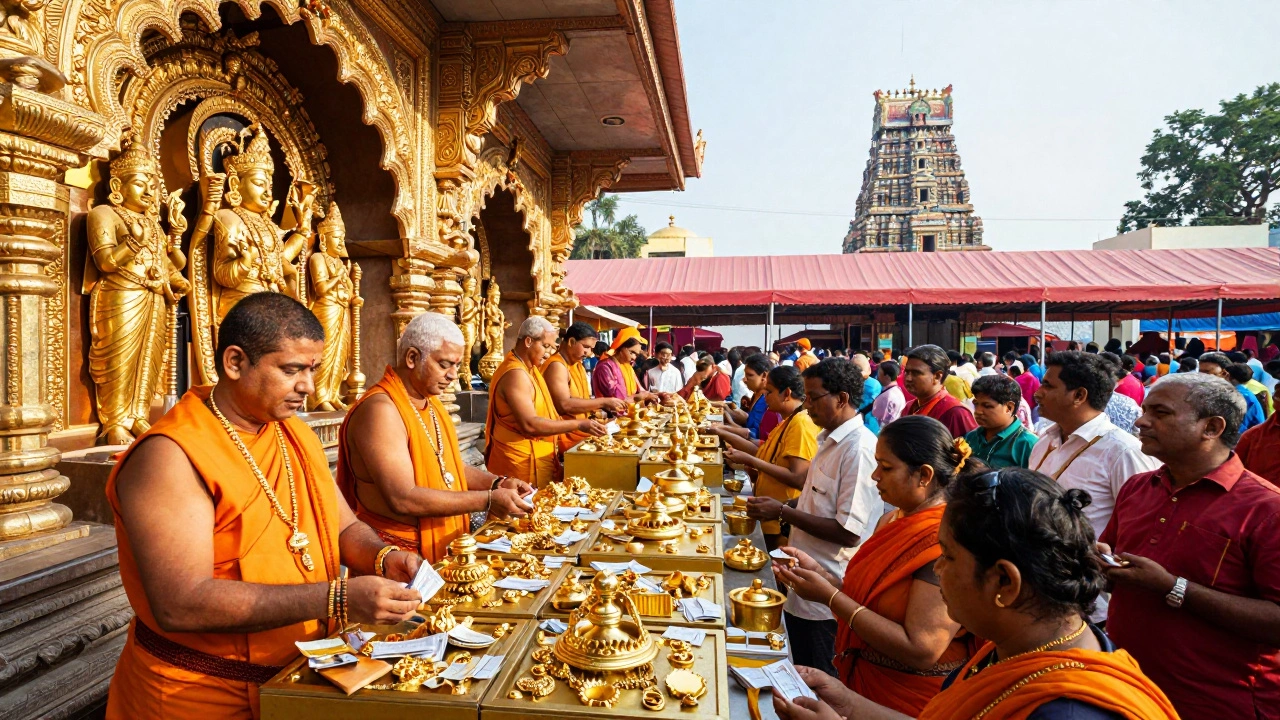
While Padmanabhaswamy holds ancient treasure, Tirupati Balaji, the Venkateswara Temple in Andhra Pradesh, is the temple that collects the most money every single day. Over 50,000 pilgrims visit daily. On big festival days, that number hits 300,000. And each one brings offerings: gold, cash, silver, even electronic devices. The temple’s annual income? Around ₹12,000 crore ($1.5 billion USD). That’s more than many Fortune 500 companies earn.
What makes this different? The money isn’t locked away. It’s used. The temple runs hospitals, schools, and free food programs that serve over 100,000 meals a day. It owns a bank, a radio station, and a massive land portfolio across South India. The temple even has its own police force. The wealth here isn’t hidden-it’s reinvested into public service. That’s why Tirupati doesn’t just have money-it has influence.
How Do Temples Get So Rich?
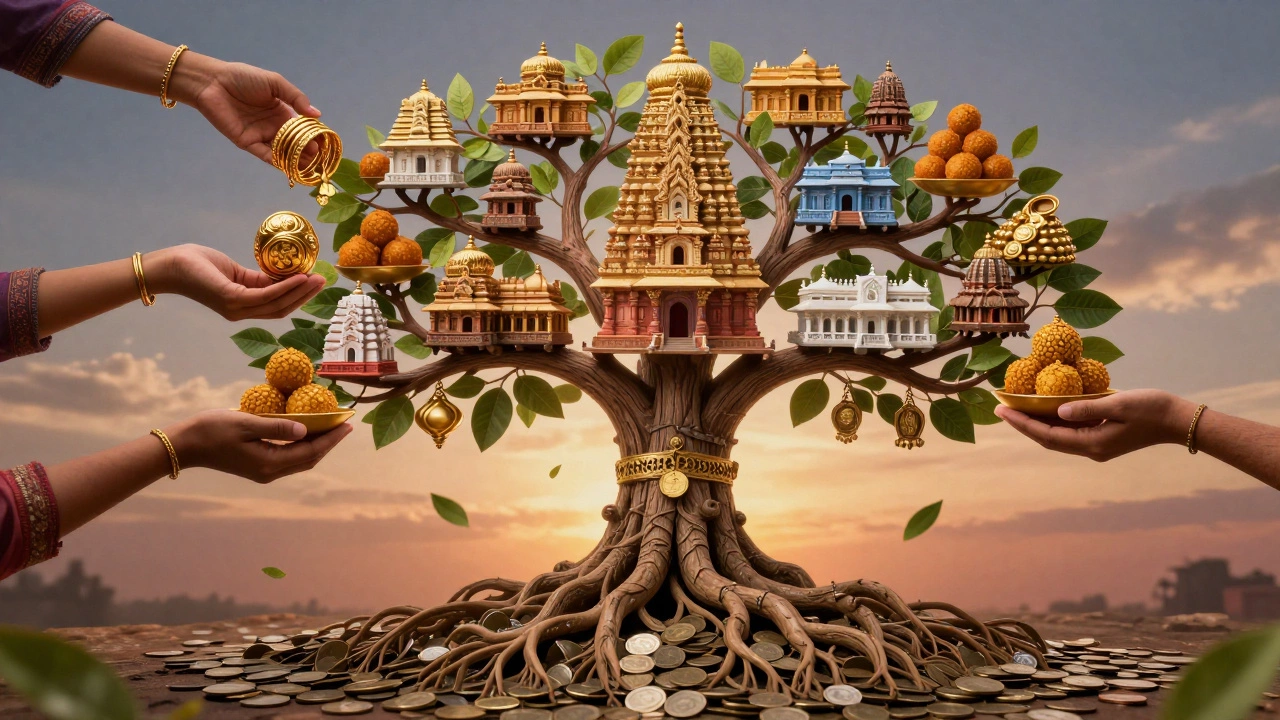
You might think this wealth came from kings. And yes, it did. The Vijayanagara Empire, the Travancore royal family, and Mughal nobles all donated gold, land, and jewels to temples as acts of devotion. But modern wealth? That comes from millions of ordinary people.
Every year, families sell land, cars, or jewelry to make offerings. Some leave their entire inheritance to the temple. Others donate gold hairpins, bangles, or coins-hundreds of thousands of them. The Tirupati temple alone receives over 10 tons of gold annually. That’s enough to make 300,000 small idols. The temple then melts it down and recasts it, selling the gold back to jewelers. The profit? Reinvested into more temples, schools, and clinics.
There’s no tax on temple income in India. That’s because temples are considered religious institutions under the Hindu Religious and Charitable Endowments Act. So while private donors pay 30% tax on donations, temples pay 0%. That’s one reason why their wealth grows so fast.
Other Major Contenders
Padmanabhaswamy and Tirupati lead-but they’re not alone.
- Sri Ranganathaswamy Temple in Srirangam, Tamil Nadu: One of the largest temple complexes in the world. It owns over 1,000 acres of land and runs a network of schools and hospitals.
- Shree Jagannath Temple in Puri, Odisha: Known for its annual Rath Yatra. It receives millions in offerings and owns vast agricultural land. The temple’s kitchen feeds over 100,000 people daily.
- Kashi Vishwanath Temple in Varanasi: Though its physical structure was rebuilt after destruction, its spiritual wealth is unmatched. Donations here are tied to rituals for the dead-families pay to have ashes immersed in the Ganges. The temple collects over ₹2,000 crore yearly.
Each of these temples has its own system. Some rely on land rent. Others on pilgrimage tourism. A few, like the one in Puri, even have their own printing presses that produce religious texts sold worldwide.
Why Does This Matter?
It’s easy to think of temples as just places of worship. But in India, they’re economic engines. They employ tens of thousands-priests, cooks, cleaners, accountants, security staff. They’re the largest non-government employers in many states. They’re also the most trusted institutions. When banks fail, people trust temples with their savings. When the government can’t provide healthcare, temples step in.
There’s controversy too. Critics say temple wealth should be taxed. Others argue it’s cultural heritage. The Supreme Court has ruled that temple funds are not state property. But debates continue. In 2023, a new bill proposed that temples with income over ₹500 crore must disclose financial statements. So far, it’s stalled.
What You Can See Today
If you visit Tirupati, you’ll see the gold-plated idol, the massive donation halls, and the free meals served under giant tents. You won’t see the vaults, but you’ll feel the energy of money flowing in.
At Padmanabhaswamy, you’ll see the temple’s quiet beauty-no cameras allowed, no flash photography. The gold is hidden, but the devotion is visible. Pilgrims leave offerings of flowers and coconut. They don’t need to see the vaults to believe in their power.
Both temples are open to all faiths. You don’t have to be Hindu to visit. But you do need to respect the rules: no leather, no shoes, no phones inside the inner sanctum. That’s not just tradition-it’s part of what keeps the wealth sacred.
Final Thought: Richness Isn’t Just in Gold
So, which temple is richest in India? If you measure by gold and jewels, it’s Padmanabhaswamy. If you measure by daily income and social impact, it’s Tirupati. But the real answer? It’s both. And more. Because in India, temples aren’t just buildings. They’re living institutions-funded by faith, sustained by community, and protected by law.
Next time you hear "richest temple," don’t just think of treasure. Think of millions of hands giving, of rituals passed down for centuries, of hospitals built with prayers. That’s the real wealth.
Is the Padmanabhaswamy Temple’s treasure really worth $22 billion?
Yes, based on the 2011 inventory by the Supreme Court-appointed committee, the value of the gold, jewels, and artifacts found in Vaults A, C, D, E, and F was estimated at over $22 billion. This includes over 18,000 gold idols, 700 kg of pure gold, and 1,000-year-old coins. The valuation was done by independent gemologists and gold experts. Vault B remains unopened due to religious beliefs.
Does the Tirupati Temple really make $1.5 billion a year?
Yes. According to the temple’s own audited financial reports, the Tirupati Balaji Temple collected ₹12,000 crore (approximately $1.5 billion USD) in 2024. This comes from donations, gold offerings, and revenue from temple-run businesses like the sale of laddus, land leases, and its bank. It’s one of the highest-earning religious institutions in the world.
Can tourists visit the vaults of Padmanabhaswamy Temple?
No. The vaults are not open to the public or even to most temple staff. Only a small group of trustees and court-appointed officials have access. The temple follows strict religious protocols, and the vaults are considered sacred, not tourist attractions. Visitors can see the outer temple and the main deity, but the inner chambers remain sealed.
Why don’t Indian temples pay taxes?
Under the Hindu Religious and Charitable Endowments Act of 1951, temples are classified as religious institutions, not businesses. Their income is exempt from income tax because it’s used for religious and charitable purposes. This includes food distribution, education, and healthcare. The law treats temple funds as belonging to the deity, not to any individual or government.
Are there any temples richer than Tirupati or Padmanabhaswamy?
No temple in India surpasses these two in total wealth. Other major temples like Jagannath in Puri or Ranganathaswamy in Srirangam are very wealthy, but their annual income and asset value are significantly lower. Globally, only a few religious institutions, like the Vatican or the Islamic Waqf properties, hold comparable assets-but none match the unique combination of ancient treasure and modern income that these two Indian temples have.


About Author